
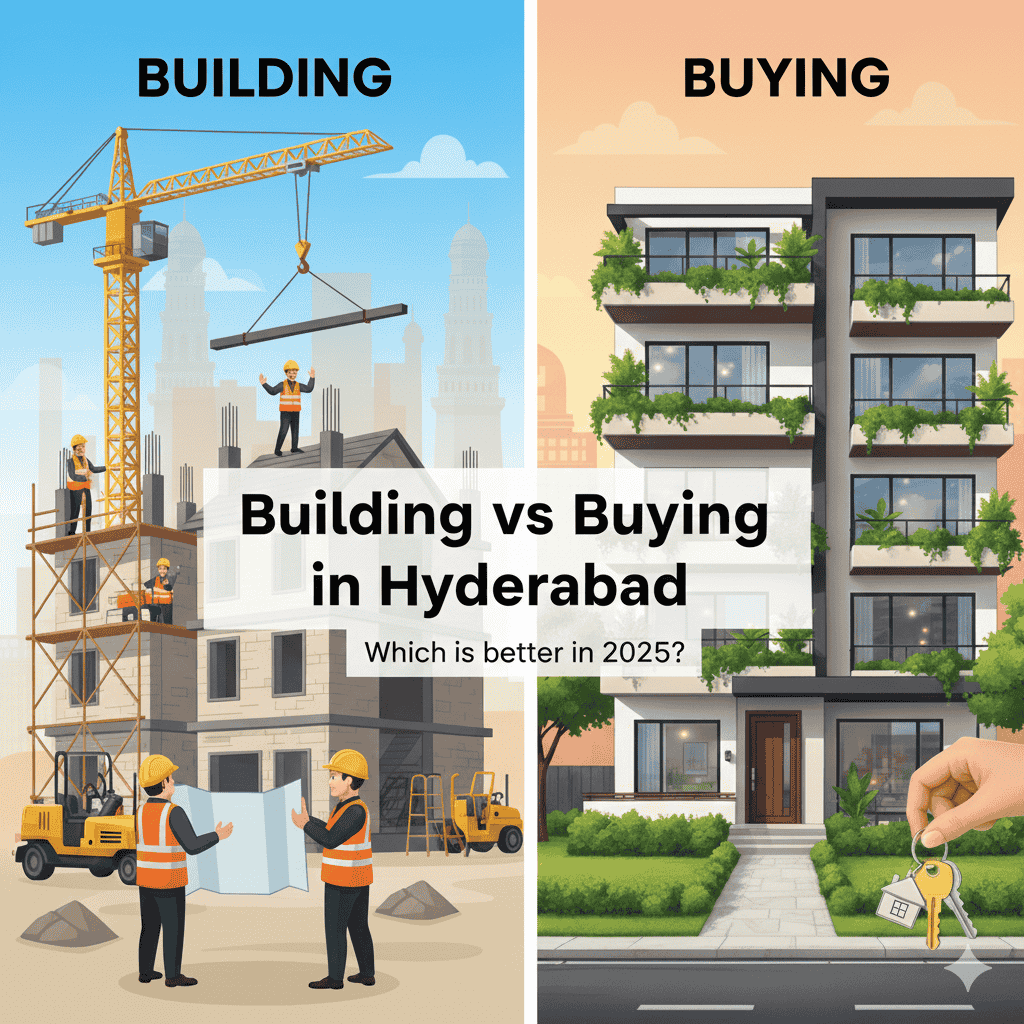

Building vs Buying: Which Is Better in the Hyderabad Real Estate Market?
When you’re thinking about a home in Hyderabad, many people wonder: Should I build or buy a home in India — especially in a city like Hyderabad? This often comes down to the classic question: building vs buying a home in Hyderabad. Should you buy a ready-made house/ flat from a builder, or buy land and build your own house instead? Both options have advantages and drawbacks — the best choice depends on your priorities: cost, control, time, risk, and long-term plans.
Why This Decision Matters — Especially in Hyderabad
Hyderabad’s real-estate landscape adds some unique complexities to this decision. Recent regulation changes around buffer zones, water-body protection, and land-use approvals have made building on land more legally sensitive than ever.
For many homebuyers asking “should I build or buy a home in India?”, especially if they are considering Hyderabad, these regulatory issues tilt the balance. Therefore, it’s important to evaluate both paths carefully before investing.
Building Your Own Home: Pros & Cons
Advantages of Building
- Full Control Over Design and Layout
When you build, you choose every detail: floor plan, room layout, interior finishes (tiles, flooring, and fixtures), quality of construction, landscaping, and future-ready spaces. This lets you tailor the home exactly to your family’s needs and lifestyle. - Flexibility and Customization
You can build at your own pace (if finances permit), scale the design based on budget, include custom touches, and even plan for future expansions, such as a terrace, basement, or extra rooms. Many prefer building because of this freedom. - Potential Cost Savings (If Managed Well)
Building may sometimes be cheaper than buying a ready house, providing you source materials smartly, control labour costs, and avoid unnecessary markups. The possibility of saving on overall cost is often cited as a major benefit. - Opportunity for Modern, Energy-Efficient & Custom Features
When you design a house from scratch, you can incorporate energy-efficient materials, modern amenities, and layout designs tailored to long-term comfort — features often lacking in older homes. - Personal Satisfaction and Long-Term Value (If Done Right)
A thoughtfully built house may offer better long-term value, especially if you use quality materials and plan carefully, possibly attracting better resale value later if maintained.
Risks and Challenges of Building
- Time-Consuming and Requires Constant Oversight
Building a house from the ground up typically takes months — often 12–18 months or more, depending on design complexity, labour, supply chain, and approvals. Delays — due to weather, materials, labour, or regulatory bottlenecks — are common.
You also need to manage everyday supervision: quality control, materials procurement, vendor coordination, labour management, and finishing, which can be stressful and time-intensive. - Legal, Regulatory and Land-Title Risks (Especially in Hyderabad)
In Hyderabad, building on land requires due diligence — title clarity, approvals, compliance with environmental and zoning laws, buffer zones near water bodies, and more. Failure to check these can lead to serious issues — even demolition or refusal by authorities.
For example, recent changes enforcing wide buffer zones around lakes and water bodies make many lands risky for construction. - Quality Uncertainty and Risk of Overruns
If you engage contractors without solid credentials or fail to monitor construction, there is a risk of subpar workmanship, delays, structural problems, or poor finishing.
Also, materials and labour costs can increase unpredictably, leading to cost overruns. Many building projects end up more expensive than initially planned. - Long Wait Before You Can Move In
Unlike buying a ready house, building means you cannot move in immediately. The process from planning to completion can take a year or more before you finally get a livable home, which may not suit everyone’s schedule or needs. - Heavy Initial Effort, Time, and Stress
Managing construction is complex — from hiring architects/engineers to coordinating laborers, vendors, permits, and timelines. For many, especially first-time builders, this can be overwhelming.
Buying from a Reputable Builder or Pre-Ready House: Pros & Cons
Advantages of Buying
- Legal Clarity, Compliance, and Less Regulatory Risk
Established builders usually handle all required approvals, title checks, regulatory compliances (environmental, zoning, statute, etc.) before marketing the property. This removes a big chunk of legal risk for buyers. - Convenience and Predictability
Buying a ready property means you don’t need to oversee construction, coordinate vendors, or worry about material procurement. Once the paperwork is done and financing is arranged, you can get possession relatively quickly. - Defined Cost and Timeline (Less Risk of Overruns)
Unlike building, where cost and schedule may vary, buying a finished house has a fixed price. You don’t need to worry about rising material/labour costs, price escalations, or construction delays. - Established Infrastructure & Amenities
Ready properties are usually in developed localities with existing amenities: roads, utilities (water, sewage, electricity), schools, shops, connectivity, etc. This saves time and gives lifestyle benefits from day one. - Lower Initial Effort and Stress
Buying a home eliminates the need for coordinating architects, contractors, labour, and building materials, which can be a relief, especially for those unfamiliar with construction. It’s a more hassle-free, predictable path to homeownership.
Drawbacks of Buying
- Limited Customization
Ready houses often come with predefined layouts, finishes, and structures. You may get limited options to modify rooms, flooring, interiors, or other features. Customization, if possible, can be expensive or impractical. - Potentially Higher Per-Unit Cost
Builder-developed houses/ flats often include margins — for marketing, compliance, amenities, brand value, overheads. As a result, the cost per square foot may be higher than self-built houses when you account for bare structure + material + labour. - Dependence on Others’ Quality Standards
You rely completely on the builder’s quality control — materials chosen, finishing, structural integrity, and vendor choices. Even reputed builders can sometimes cut corners or prioritize profit over long-term quality. - Recurring Costs, Maintenance, Hidden Fees, or Less Energy Efficiency
Older homes or mass-built apartments may have less energy-efficient design. Sometimes, maintenance issues surface after a few years (plumbing, wiring, building wear & tear). - Lack of Personalization to Lifestyle & Future Needs
Pre-defined layouts may not match future lifestyle needs (extra rooms, terrace, open layout, home office, etc.) — renovation could be expensive or structurally constrained.These are the main factors to keep in mind for building vs buying a home in Hyderabad.
What Makes Hyderabad Different — Regulatory & Legal Context Matters
If you are considering building or buying in Hyderabad, there is a critical factor to keep in mind: regulatory and environmental compliance.
- The city authorities — Hyderabad Metropolitan Development Authority (HMDA) and Greater Hyderabad Municipal Corporation (GHMC) — have recently halted permissions for new layouts near lakes and water bodies due to confusion around buffer-zones and full tank levels (FTL).
- Under the updated Layout Regularization Scheme (LRS), buffer zones restrictions around lakes / water-bodies have expanded dramatically in many cases.
- Building on or near water bodies — or previously unregulated lands — carries significant risk: projects may be stalled, facing demolition, or subject to withdrawal of approvals.
- Lending institutions such as banks are becoming cautious — even for approved properties — if there is any ambiguity about compliance.
All this means that in Hyderabad, the “should I build or buy a home in India” decision must heavily factor in legal clarity and risk — not just cost or design preferences.
For Many Homebuyers in Hyderabad, Buying Often Makes More Sense
Given the trade-offs, for many homebuyers — especially those without time for constant oversight, construction expertise, or appetite for legal and regulatory due diligence — buying from a trusted, transparent builder tends to be the safer, more reliable path.
Yes, you may get slightly less control over design and customization, and you may pay a premium compared to a bare-bones build. But the benefits are significant:
- Legal clarity and reduced risk of regulatory issues
- Faster move-in timeline and convenience
- Predictable costs with minimal chance of overruns
- Established infrastructure, amenities, and neighborhood benefits
Especially in a city like Hyderabad, where water-body regulations, buffer zones, and stricter scrutiny are real factors, buying offers far more peace of mind.
That said, building your own home can be an excellent option if you:
- Already own land with a clean title and no regulatory red flags
- Are willing to invest time, effort, and oversight into construction
- Want a highly personalized home tailored to your lifestyle
- Are ready to manage the complexity of procurement, labor, and approvals
For many, this makes sense — but only if carefully planned and diligently executed.
Tips for Hyderabad Homebuyers (Whether Building or Buying a Home in Hyderabad)
- Always verify land title, survey number, and approvals — especially if buying land to build. Confirm that the property is not under FTL or buffer-zone restriction per HMDA/HYDR A records.
- Ask for all relevant NOCs, environmental clearances, and zoning compliance documents before signing any agreement.
- If building: plan carefully — factor in realistic timelines, contingencies for material/labour cost increases, and frequent oversight or hiring a reliable project manager.
- If buying: check builder history, quality of construction, and compliance with regulations; verify amenities, publisher’s disclosures, and actual infrastructure readiness.
- Consider future resale value and long-term maintenance costs — energy efficiency, build quality, location, infrastructure, and legal clarity all impact long-term value.
Deciding whether buying vs building a home in Hyderabad — Or more broadly, should I build or buy a home in India — depends on what you value more: control and customization, or convenience and certainty.
- If you prioritize speed, convenience, lower hassle, legal safety, and predictable cost, buying from a reputable builder is generally the better choice — especially in cities like Hyderabad with regulatory complexities.
- If you value personalization, control, custom design, and potentially lower cost — and are ready for careful planning, rigorous oversight, and risk — building your own home can pay off.
Given the current regulatory climate in Hyderabad (with stricter buffer-zone norms and water-body protections), for many homebuyers, the safer and more reliable route remains buying. But if you do choose to build, do so with care — after thorough due diligence, planning, and realistic budgeting. These are the main factors to keep in mind for building vs buying a home in Hyderabad.